Click here to take the survey and receive your certificate.
CGM Patient Video
References:
Centers for Disease Control and Prevention. National Diabetes Statistics Report. May 15, 2024. Accessed December 23, 2025.
Schaffer R. We have to make it easy: Barriers hinder CGM access for some people with diabetes. May 24, 2023. Accessed February 21, 2025.
Unger J, Kushner P, Anderson JE. Practical guidance for using the FreeStyle Libre flash continuous glucose monitoring in primary care. Postgraduate Medicine. 2020;132(4):305-313. doi:10.1080/00325481.2020.1744393
Carls G, Huynh J, Tuttle E, Yee J, Edelman SV. Achievement of Glycated Hemoglobin Goals in the US Remains Unchanged Through 2014. Diabetes Ther. 2017;8(4):863-873. doi:10.1007/s13300-017-0280-5
Oser TK, Hall TL, Dickinson LM, et al. Continuous Glucose Monitoring in Primary Care: Understanding and Supporting Clinicians' Use to Enhance Diabetes Care. Use to Enhance Diabetes Care. Ann Fam Med. 2022;20(6):541-547. doi:10.1370/afm.2876
American Diabetes Association Professional Practice Committee for Diabetes*, Bajaj M, McCoy RG, et al. 7 Diabetes Technology: Standards of Care in Diabetes-2026. Diabetes Care. 2026;49(Supplement_1):S150-S165. doi:10.2337/dc26-S007
Grunberger G, Sherr J, Allende M, et al. American Association of Clinical Endocrinology Clinical Practice Guideline: The Use of Advanced Technology in the Management of Persons With Diabetes Mellitus. Endocrine Practice. 2021;27(6):505-537. doi:10.1016/j.eprac.2021.04.008
Simonson GD, Holt EH, Grady M, Hurrell G, Gaudiani LM, Bergenstal RM. Unleashing the Potential of Blood Glucose Monitoring Data With the Ambulatory Glucose Profile Report. Clin Diabetes. 2024;42(4):550-560. doi:10.2337/cd23-0092
Ferreira ROM, Trevisan T, Pasqualotto E, et al. Continuous Glucose Monitoring Systems in Noninsulin-Treated People with Type 2 Diabetes: A Systematic Review and Meta-Analysis of Randomized Controlled Trials. Diabetes Technology & Therapeutics. 2024;26(4):252-262. doi:10.1089/dia.2023.0390
Miller EM. Using Continuous Glucose Monitoring in Clinical Practice. Clin Diabetes. 2020;38(5):429-438. doi:10.2337/cd20-0043
Klonoff DC. Hemoglobinopathies and Hemoglobin A1c in Diabetes Mellitus. J Diabetes Sci Technol. 2020;14(1):3-7. doi:10.1177/1932296819841698
Mayberry LS, Guy C, Hendrickson CD, McCoy AB, Elasy T. Rates and Correlates of Uptake of Continuous Glucose Monitors Among Adults with Type 2 Diabetes in Primary Care and Endocrinology Settings. J GEN INTERN MED. 2023;38(11):2546-2552. doi:10.1007/s11606-023-08222-3
Ajjan R, Slattery D, Wright E. Continuous Glucose Monitoring: A Brief Review for Primary Care Practitioners. Adv Ther. 2019;36(3):579-596. doi:10.1007/s12325-019-0870-x
Czupryniak L, Dzida G, Fichna P, et al. Ambulatory Glucose Profile (AGP) Report in Daily Care of Patients with Diabetes: Practical Tips and Recommendations. Diabetes Ther. 2022;13(4):811-821. doi:10.1007/s13300-022-01229-9
Battelino T, Danne T, Bergenstal RM, et al. Clinical Targets for Continuous Glucose Monitoring Data Interpretation: Recommendations From the International Consensus on Time in Range. Diabetes Care. 2019;42(8):1593-1603. doi:10.2337/dci19-0028
Zhang Z, Wang Y, Lu J, Zhou J. Time in tight range: A key metric for optimal glucose control in the era of advanced diabetes technologies and therapeutics. Diabetes Obesity Metabolism. 2025;27(2):450-456. doi:10.1111/dom.16033
Arriazola J, Wollen J, Davis S, Wang EM, Tran G, Rosario N. Review of Over the Counter and Prescription Continuous Glucose Monitoring. J Pharm Pract. 2025;38(6):493-498. doi:10.1177/08971900251328832
Chamberlain JJ. Patient Selection for Continuous Glucose Monitoring. In: Role of Continuous Glucose Monitoring in Diabetes Treatment. American Diabetes Association; 2018. Accessed February 21, 2025.
Martens TW, Parkin CG. How use of continuous glucose monitoring can address therapeutic inertia in primary care. Postgrad Med. 2022;134(6):576-588. doi:10.1080/00325481.2022.2080419
Centers for Medicare & Medicaid Services. Glucose Monitors (L33822). October 9, 2024. Accessed December 18, 2024.
Adkison JD, Chung PE. Implementing Continuous Glucose Monitoring in Clinical Practice. Fam Pract Manag. 2021;28(2):7-14.
Zadel AH, Chiampas K, Maktaz K, et al. Continuous Glucose Monitoring in Primary Care: Multidisciplinary Pilot Implementation Study. JMIR Diabetes. 2025;10:e69061. doi:10.2196/69061
Bergenstal RM. Roadmap to the Effective Use of Continuous Glucose Monitoring: Innovation, Investigation, and Implementation. Diabetes Spectrum. 2023;36(4):327-336. doi:10.2337/dsi23-0005
Jin X, Cai A, Xu T, Zhang X. Artificial intelligence biosensors for continuous glucose monitoring. Interdisciplinary Materials. 2023;2(2):290-307. doi:10.1002/idm2.12069
Vettoretti M, Facchinetti A. Combining continuous glucose monitoring and insulin pumps to automatically tune the basal insulin infusion in diabetes therapy: a review. Biomed Eng Online. 2019;18(1):37. doi:10.1186/s12938-019-0658-x
Association of Diabetes Care & Education Specialists (ADCES). Insulin Pumps l Understanding CGM & Pump Integration. ADCES. January 25, 2025. Accessed February 21, 2025.
Kong YW, Morrison D, Lu JC, Lee MH, Jenkins AJ, O’Neal DN. Continuous ketone monitoring: Exciting implications for clinical practice. Diabetes Obesity Metabolism. 2024;26(S7):47-58. doi:10.1111/dom.15921
Dhatariya K. Blood Ketones: Measurement, Interpretation, Limitations, and Utility in the Management of Diabetic Ketoacidosis. Rev Diabet Stud. 2016;13(4):217-225. doi:10.1900/RDS.2016.13.217
Jaromy M, Miller JD. Potential Clinical Applications for Continuous Ketone Monitoring in the Hospitalized Patient with Diabetes. Curr Diab Rep. 2022;22(10):501-510. doi:10.1007/s11892-022-01489-6
Kerr D. Integrating Ketone and Glucose Monitoring for Optimized Diabetes Management: Key Ketone Monitoring Updates and Highlights from the ADA 2025 Conference [Podcast]. Diabetes Metab Syndr Obes. 2025;18:2623-2628. doi:10.2147/DMSO.S555697
American Diabetes Association. Panel to spotlight potential of continuous ketone monitoring. ADA Meeting News. June 11, 2025. Accessed October 20, 2025.
Nguyen KT, Xu NY, Zhang JY, et al. Continuous Ketone Monitoring Consensus Report 2021. J Diabetes Sci Technol. 2022;16(3):689-715. doi:10.1177/19322968211042656
Hepprich M, Roser P, Stiebitz S, et al. Awareness and knowledge of diabetic ketoacidosis in people with type 1 diabetes: a cross-sectional, multicenter survey. BMJ Open Diab Res Care. 2023;11(6):e003662. doi:10.1136/bmjdrc-2023-003662
Albanese-O’Neill A, Wu M, Miller KM, Jacobsen L, Haller MJ, Schatz D. Poor Adherence to Ketone Testing in Patients with Type 1 Diabetes. Diabetes Care. 2017;40(4):e38-e39. doi:10.2337/dc16-2620
Abbott. Abbott’s Biowearable: One Sensor for Glucose, Ketones | Newsroom. June 17, 2022. Accessed December 29, 2025.
American Diabetes Association (ADA) Standards of Care in Diabetes - 2026
ADA's Standards of Care is the gold standard in evidence-based guidelines for diagnosing and managing diabetes and prediabetes. Based on the latest scientific research and clinical trials, the Standards of Care includes strategies for diagnosing and treating diabetes in children, adolescents, and adults; methods to prevent or delay diabetes and its associated comorbidities like obesity; and care recommendations to enhance health outcomes.
Ketoacidosis: two new infographics from the ADA: https://bit.ly/3ZXusiu
How Much Does a Continuous Glucose Monitor Cost and Will Insurance Pay For It?
Most health insurance plans will cover some or all of the cost of diabetes equipment and supplies. Additionally, with original Medicare, Medicare Part B covers the cost of different types of self-testing equipment and supplies for people with diabetes. Many Medicare Advantage plans also cover CGMs, as do most state Medicaid programs. This article includes details, as well as resources for further research.
What is a CGM and how do I choose one?
Healthline Diabetes Mine. Updated December 14, 2021. Accessed January 3, 2022. https://www.healthline.com/diabetesmine/what-is-continuous-glucose-monitor-and-choosing-one
ADCES Playbook Series: Implementing CGM Into Your Practice
Continuous glucose monitoring has become a game changer in the quest to achieve glucose management goals. We have partnered with key healthcare stakeholders to create a series of playbooks that give you a step-by-step approach to leveraging this new technology in your practice.
AAFP: Continuous Glucose Monitoring (CGM)
Continuous Glucose Monitors (CGM) use is on the rise. Primary care practices play an important role in managing the health of patients with diabetes. Achieving glycemic targets is important in preventing short- and long-term complications, yet many patients with diabetes don't achieve recommended targets. CGM can reduce or eliminate the need for fingerstick capillary glucose testing, and provide richer information about average glycemia, hyperglycemia, hypoglycemia, and glucose variability. The goal of this guide from AAFP is to help primary care physicians navigate prescribing and ordering CGM.
AACE Guide To Continuous Glucose Monitoring (CGM)
Unsure where to begin? Here’s a step-by-step guide to getting started with personal and professional CGM devices in your practice. Includes training and resources on billing, coding, when to refer, and more.
Professional Glucose Monitoring Implementation Handbook. Association of Diabetes Care & Education Specialists and the American Association of Nurse Practitioners
Continuous glucose monitoring has become a game changer in the quest to achieve glucose management goals. We have partnered with key healthcare stakeholders to create a series of playbooks that give you a step-by-step approach to leveraging this new technology in your practice.
Using Continuous Glucose Monitoring in Clinical Practice (Clinical Diabetes)
Continuous glucose monitoring (CGM) systems are more than just glucose monitors. The robust data garnered from CGM can also be used for detection of trends, identification of asymptomatic events, and review of glycemic variability over a range of time. CGM is poised to radically change the treatment of diabetes and patient engagement of those afflicted with this disease.
Continuous Glucose Monitors and Reduced Diabetes-Related Hospitalizations in Patients with T2D and CKD
Diabetes Technology: Standards of Medical Care in Diabetes–2024
Diabetes technology has expanded to include automated insulin delivery (AID) systems, where CGM-informed algorithms modulate insulin delivery, as well as diabetes self-management support software serving as medical devices. Diabetes technology, when coupled with education, follow-up, and support, can improve the lives and health of people with diabetes; however, the complexity and rapid evolution of the diabetes technology landscape can also be a barrier to implementation for both people with diabetes and the health care team.
Applied Policy Helps Define The Path For CGM Expansion
The Centers for Medicare and Medicaid Services (CMS) is considering expanding coverage for continuous glucose monitors (CGMs) which could positively impact the lives of millions of Medicare beneficiaries with diabetes. These proposed modifications to coverage were considered during a virtual public meeting held in November 2022, and a final decision on the expansion is expected in 2023.
Clinical Targets for Continuous Glucose Monitoring Data Interpretation: Recommendations From the International Consensus on Time in Range
Successful utilization of CGM technology in routine clinical practice remains relatively low. This may be due in part to the lack of clear and agreed-upon glycemic targets that both diabetes teams and people with diabetes can work toward. This article summarizes the ATTD consensus recommendations for relevant aspects of CGM data utilization and reporting among the various diabetes populations.
ADA Standards of Medical Care in Diabetes — 2024: Glycemic Goals and Hypoglycemia
CGM technology has grown rapidly in accuracy, affordability, and accessibility. The data on TIR, hypoglycemia, and hyperglycemia are available to providers and patients via the AGP report (Figure 6.1, below), which offers visual cues and recommendations to assist in data interpretation and treatment decision-making. Click image for larger.
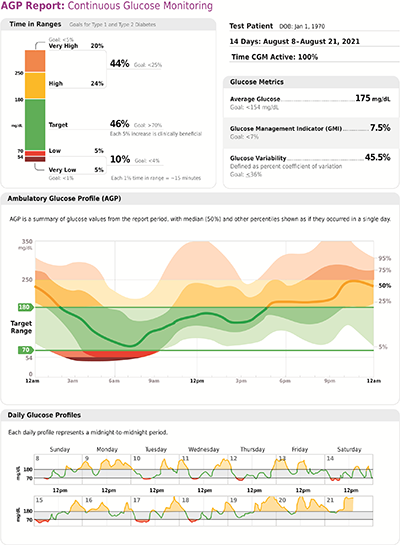
Ambulatory Glucose Profile (AGP) Report in Daily Care of Patients with Diabetes: Practical Tips and Recommendations
The AGP report provides both a visual and a statistical summary of the glucose metrics that, as agreed in the 2019 international consensus for assessing glycemic control, should be analyzed in all people with diabetes who are using CGM systems. The AGP report can be analyzed in a systematic fashion to understand current glycemic control and to monitor, in real time, the impact of adjustments to therapy in both type 1 diabetes and type 2 diabetes.
Manufacturer-provided CGM Resources for Healthcare Professionals from: